LangGraph Integration
This document is a top-down walkthrough of the Dragon backend for LangGraph for developers who will maintain and extend it. It starts with the big picture — what the integration does and how the code is organized — then traces a single node invocation through the system end-to-end, and finally drills into each component in the order a request touches it.
For the Python API reference, see LangGraph Integration.
1 — What This Integration Does
The Dragon LangGraph backend lets an existing LangGraph StateGraph run
across the nodes of an HPC cluster without changing the graph definition or the
node functions. The user writes ordinary LangGraph code; the only difference is
that each node function executes inside a persistent Dragon AgentHost process
rather than in the local interpreter — a sync (def) node on the host’s thread
pool, an async (async def) node on the host’s event loop. Agents co-located on
the same host share memory, LLM clients, and other heavyweight resources.
The design splits cleanly into a control plane, an execution plane, and a data plane:
Control plane (owned by this integration). Node dispatch, result transport, completion signaling, backpressure, and result routing. Agent results travel inline as small
cloudpickleenvelopes over shared Dragon Channels. This is how a task gets there and how its result comes back.Execution plane (shared — integration provides the host, user provides the compute). Where the node function actually runs: a persistent Dragon AgentHost process, its thread pool, agent co-location and resource sharing,
Policyplacement, and anyProcess/ProcessGroup/Batchthe agent itself launches — and supervises and aborts mid-flight. This is where the science actually runs, and how it scales out and is steered.Data plane (owned by the user). Bulk scientific data (tensors, arrays, datasets) belongs in a user-managed
DDict. Agent functions store artifacts there and return only a lightweight handle/key through LangGraph state. This integration never creates or manages a DDict, and never moves bulk bytes through its transport. This is where large data lives and moves.
In one line: control = signaling, execution = compute, data = storage.
LangGraph keeps full ownership of topology, routing, and checkpointing;
Dragon owns process placement, IPC, and completion signaling. The two
layers meet at exactly one seam — a fn(state) -> dict
callable per node.
Why Dragon on HPC
Agentic AI and HPC science are converging. The graph that decides what to do next — which simulation to launch, which region to refine, which candidate to keep — increasingly sits next to petascale compute and the multi-gigabyte artifacts it produces. The hard part is no longer “call an LLM”; it is keeping the agent layer next to the data, so a decision does not cost a network round-trip of every result. Dragon addresses this with the in-situ agent — the deciding graph runs in place, inside the allocation, next to the data and compute it reasons about.
Today this means integrating several separate systems. Plain LangGraph runs
every node in the driver process (threads for invoke, asyncio tasks for
ainvoke): it is bounded by one node’s cores and one GIL, with no way to place
work near data. The usual workaround stitches together a workflow layer (such as
Parsl), a central store (such as Redis) so agents exchange results by key, and a
separate inference server for the LLMs — three or four systems to operate, and
results still pass by value through the store, so every GB-scale artifact is
serialized and copied over the network, often several times.
In-situ agents run inside the allocation, next to the data. The graph, the
agents, the simulations, and the data all live in the same Dragon runtime
spanning every node you were allocated. Backing each node with a Dragon
AgentHost process, the same graph now:
Spans the allocation.
launch_host(..., policy=...)pins each agent host to a specific node, NUMA zone, or GPU set (through aPolicy). Because you decide where each host lands, an agent can run on the same node where its data already lives.Runs agents in real parallel, and lets them drive HPC jobs. Each node function runs inside a host process out on the allocation, rather than on the driver’s single interpreter. A step that fans out to many agents therefore executes concurrently across many nodes, instead of being serialized by one Python GIL. An agent can also launch its own Dragon
ProcessGrouporBatchjob of hundreds of ranks, supervise it, and abort it early if the partial results look wrong. In other words, a single decision node in the graph can steer a full-scale simulation.Keeps bulk data node-local. When an agent produces a large result, it writes that result to the node-local
DDictmanager, which lives in shared memory on the same node, so the write needs no serialization and no network copy. The agent then returns only a small handle (a key) through LangGraph state. The orchestrator passes handles between nodes and never moves the gigabytes themselves.Moves data over the HPC fabric, not TCP. If a later agent has to read data that lives on another node, Dragon transfers it over the cluster interconnect (RDMA/HSTA) rather than the slower kernel TCP stack.
Shares heavyweight resources. Agents that sit in the same host share one address space, so expensive objects such as LLM clients, model weights, and database connections are loaded once and reused by every agent on that host.
Runs inference on the same runtime. LLM serving can run inside the allocation through the Dragon inference service (on-cluster vLLM), reached over Dragon Queues and Channels. There is no separate inference server to stand up, secure, and route traffic to.
Keeps the coordinator thin. Only small result envelopes travel back through the completion path, so the single coordinator node stays lightly loaded even when a step fans out to many agents at once.
The result is one runtime instead of a stack of separate systems — workflow
execution, node-local data, and LLM inference all run on Dragon. And your graph
does not change: the same StateGraph runs on top; only the substrate
underneath does.
Note
What the runtime provides vs. what this integration adds. Running work as
real processes across the allocation, launching and supervising a
ProcessGroup/Batch, node-local zero-copy data, data-aware placement, and
RDMA transport are all properties of the Dragon runtime
(ProcessGroup + a node Policy + DDict) — you get them with or
without LangGraph. This integration adds a zero-rewrite path onto that
substrate: keep your existing StateGraph — topology, conditional edges,
checkpointing, state — and run it on Dragon, with the single-process
orchestrator no longer executing every agent itself. The execution-plane
benefit — true cross-node parallelism instead of one GIL, and agents that can
drive full HPC jobs — applies to any multi-agent graph; the data-plane benefit
is largest for data-heavy science, while for small JSON/text results a
central store works just as well.
Architecture at a glance
One coordinator process (the driver running your graph) talks to one or more
persistent AgentHost processes spread across the allocation. A single host can
host many agents — each task message carries a node_name, and the host
looks it up in its agents dict (agents[node_name]) to route the task to the
right agent function. The coordinator dispatches a task by putting a message on a
host’s input Queue; the host resolves the target agent by node_name and
runs that agent function (async on its event loop, sync on a thread pool), then
sends a small
result envelope back over a shared completion Channel, where a single
watcher thread routes it to the waiting Future. The agent function runs on the
execution plane — and may itself launch supervised Dragon compute. Bulk data
never travels the control path — it lives in a user-managed DDict on the
compute nodes.
In the diagram below, the LangGraph Pregel engine is LangGraph’s own,
built-in node scheduler — the thing graph.invoke() drives to decide which
nodes run and to merge their outputs back into state. It is unchanged by this
integration; DragonExecutor and DragonWatcher are the two pieces this
integration adds around it.
![@startuml
skinparam componentStyle rectangle
skinparam shadowing false
node "Coordinator node" {
frame "Driver process" {
[LangGraph Pregel engine] as PREGEL
[DragonExecutor] as EXEC
[DragonWatcher\n(1 recv thread / shard)] as WATCH
}
}
node "Compute node A" {
frame "AgentHost process" as HOSTA {
component "Dispatch\nagents[node_name]" as DISPA
[ThreadPoolExecutor] as POOLA
[researcher()\n(thread)] as FNA1
[writer()\n(thread)] as FNA2
}
[ProcessGroup / Batch\n(agent-launched compute)] as CMPA
}
node "Compute node B" {
frame "AgentHost process" as HOSTB {
component "Dispatch\nagents[node_name]" as DISPB
[ThreadPoolExecutor] as POOLB
[analyzer()\n(thread)] as FNB1
}
}
database "User-managed DDict\n(node-local shards)" as DDICT
PREGEL -[#green]-> EXEC
EXEC -[#green]-> WATCH
WATCH -[#green]-> DISPA : input Queue\n(task message: node_name)
WATCH -[#green]-> DISPB : input Queue\n(task message: node_name)
DISPA -[#green]-> POOLA : route by node_name
DISPB -[#green]-> POOLB : route by node_name
POOLA -[#green]-> FNA1 : submit fn(state)
POOLA -[#green]-> FNA2 : submit fn(state)
POOLB -[#green]-> FNB1 : submit fn(state)
FNA1 -[#green]-> WATCH : completion Channel\n(result envelope)
FNA2 -[#green]-> WATCH : completion Channel\n(result envelope)
FNB1 -[#green]-> WATCH : completion Channel\n(result envelope)
FNA1 -[#orange]-> CMPA : launch + supervise\n(mid-flight abort)
FNA1 ..[#blue].> DDICT : bulk artifacts
FNB1 ..[#blue].> DDICT : bulk artifacts
@enduml](../_images/plantuml-071e941370eb993e1b883dbd758737f744a72f83.png)
Green arrows are the control plane (this integration); the orange arrow is the execution plane (the agent launching and steering real compute); dotted blue arrows are the data plane (the user’s DDict). The rest of this guide follows these arrows in order.
2 — Code Organization
All source lives under src/dragon/ai/langgraph/:
Module |
Responsibility |
|---|---|
|
Public surface. Exports |
|
|
|
|
|
|
|
|
|
|
|
Completion-envelope field names and status codes shared by host and watcher so the two sides never drift. |
3 — End-to-End: One Node Invocation
When LangGraph executes a node backed by this integration, a task flows from the driver to a host and a result envelope flows back. The sequence below shows the full round trip:
Before reading the trace, it helps to know what the watcher is. The watcher
is the coordinator-side component that collects results coming back from the
hosts — it does not dispatch jobs (jobs are sent over each host’s input
Queue, steps 3–4 below). Its whole job is the return path: receive each
result envelope, deserialize it, and hand the result to the call that is waiting
for it.
To match a returning result to its caller, the watcher keeps two pieces of bookkeeping per task, both populated at dispatch time (before the job is sent):
a Future in a pending table keyed by
task_id— theFutureis the standard Python placeholder the caller blocks on, andtask_idis a unique id minted per task so the returning envelope can find it;a slot taken from a semaphore — the backpressure budget; each outstanding task holds one slot, so the slot count caps how many tasks are in flight at once.
For throughput the watcher can be split into num_shards independent
shards — parallel copies of {completion Channel + recv thread + pending
table + semaphore}, each handling a disjoint slice of tasks chosen by
hash(task_id) % num_shards. num_shards defaults to 1, so on a first
read there is simply one lane.
Two diagrams cover the two halves of a task’s life. First, dispatch — when a
request comes in, DragonAgentNode (the LangGraph node) calls
submit_task on the watcher; the watcher mints a task_id, hashes it to
pick a shard, reserves a slot from that shard (waiting if the shard is at its
concurrency cap — see §4.4 for how the sync and
async paths wait differently), records the Future in that shard’s pending table,
and only then hands the job to the host — tagging the message with that shard’s
completion Channel so the reply comes back to the right lane:
![@startuml
skinparam shadowing false
skinparam componentStyle rectangle
[DragonAgentNode\n(LangGraph node)] as N
package "DragonWatcher" {
[submit_task(state)\nmint task_id;\nshard = hash(task_id) % num_shards] as SUB
package "chosen shard (of num_shards)" {
[slots semaphore\n(backpressure)] as SEM
[pending table\n{task_id -> Future}] as PT
}
}
queue "host input Queue" as HQ
N --> SUB : __call__ / acall
SUB --> SEM : acquire a slot\n(block if none free)
SUB --> PT : register the Future\nunder task_id
SUB --> HQ : put task message\n{task_id, node_name, state,\ndone_q = this shard's Queue}
@enduml](../_images/plantuml-4a0ea5710fed000e9f88376783a335bff4744e90.png)
Fig. 40 Dispatch — a request comes in and is forwarded to a host.
Then, return — when the host’s result arrives, that same shard’s recv thread
receives it, deserializes it, matches it to the Future by task_id, resolves
it, and frees the slot:
![@startuml
skinparam shadowing false
skinparam componentStyle rectangle
[AgentHost\n(sends result envelope)] as HOST
package "DragonWatcher — one shard (of num_shards)" {
queue "completion Channel\n(durable queue)" as CH
[recv thread\nrecv_bytes + deserialize] as RT
[pending table\n{task_id -> Future}] as PT
[slots semaphore\n(backpressure)] as SEM
}
HOST --> CH : result envelope\n{task_id, status, payload}
CH --> RT : receive + cloudpickle.loads
RT --> PT : look up task_id,\nresolve its Future
RT --> SEM : release the slot
@enduml](../_images/plantuml-3b08b2bba57e050b492e99773a0d7ba13f04cecb.png)
Fig. 41 Return — a completed task’s result is resolved.
So the pending table and semaphore are populated on dispatch and drained on return, and the job itself never travels through the shard — only the small result envelope does. With that in mind, here is the full round trip; §4.4 covers sharding and backpressure in more depth.
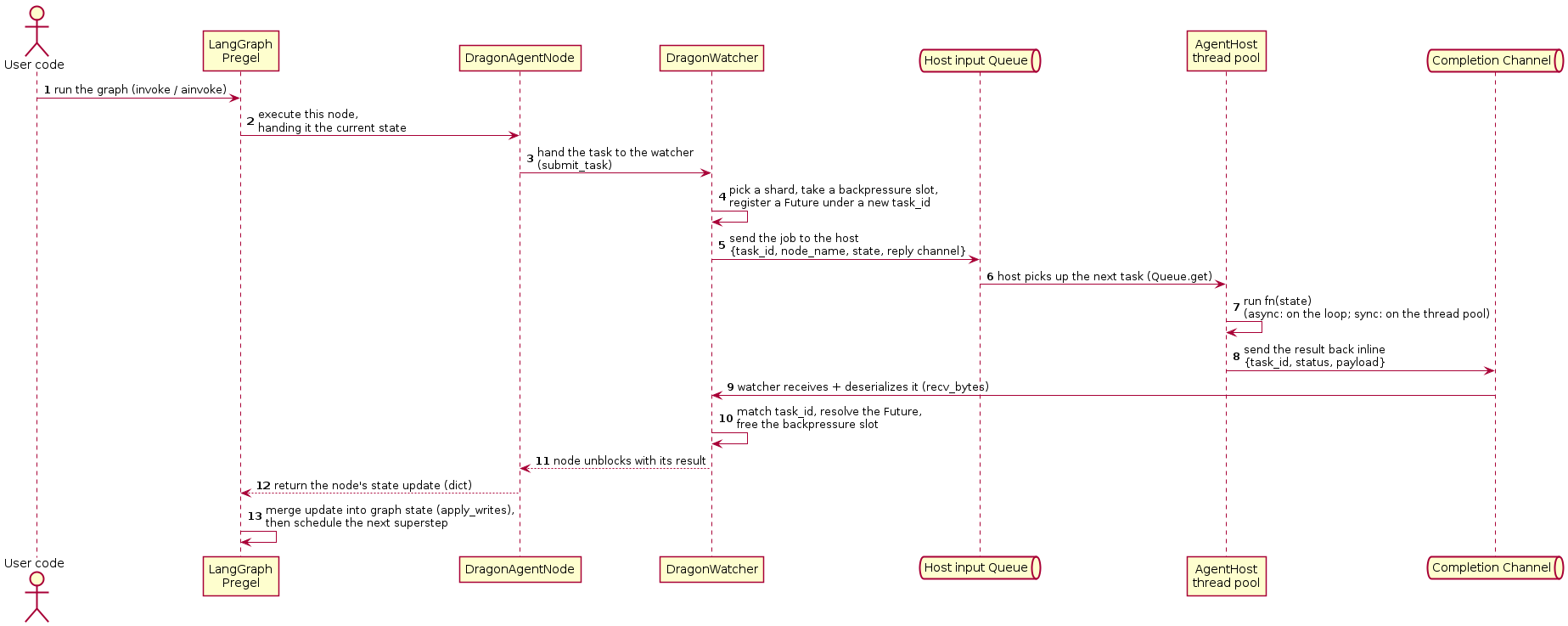
Step by step:
Dispatch.
DragonAgentNodecallssubmit_task(sync) orsubmit_task_async(async) on the watcher.Register before dispatch. The watcher picks a shard by
hash(task_id) % num_shards, acquires a backpressure slot from that shard’s semaphore, and registers a_PendingTask(carrying the Future) in the shard’s pending table — before the message leaves for the host. This is the core ordering invariant: a completion envelope can never arrive before the watcher knows which Future it resolves.To the host. The task message
{task_id, node_name, state,
serialized_done_queue}
is put on the host’s inputQueue, which cloudpickles the whole message internally — sostaterides as a raw object (no manual serialization).serialized_done_queueis the serialized descriptor of the shard’s shared completionQueue, which the host attaches to in order to reply.Execute. The host runs the node as a concurrent task —
await fn(state)on its event loop for an async node, or offloaded to its thread pool for a sync node. Co-located agents reuse the host’s shared LLM clients and weights.Reply inline. The task puts a small envelope on the completion
Queue, whoseEnvelopePicklerframes and serializes it. On success the return dict rides inline; on failure the exception does.Route and resolve. The shard’s recv thread wakes from
get, decodes the envelope, looks up the Future bytask_id, resolves it (sync:set_result; async:loop.call_soon_threadsafe), and releases the slot.Return.
DragonAgentNodehands the result back and the LangGraph Pregel engine merges the returned dict into graph state (itsapply_writesstep) before starting the next superstep — Pregel’s next scheduling round.
4 — Component Deep-Dive
4.1 — DragonExecutor (coordinator)
DragonExecutor is the user-facing lifecycle
manager and the owner of the shared result transport. It owns the single
DragonWatcher that resolves all task futures. Its responsibilities:
launch_host(agents, policy=...)— spawns one persistentdragon.native.process.Processrunningagent_host_entry, performs a handshake to receive the host’s inputQueuehandle, and registers oneDragonAgentNodeper agent. Call it multiple times (with differentPolicyobjects) to place agents on different nodes.node(name)— returns a LangGraphRunnableCallablewrapping the agent’s__call__(sync) andacall(async). This is what feedsStateGraph.add_node.shutdown(graceful=...)— sends aNonesentinel to each host, joins/kills the processes, and stops the watcher. Also runs via the context-manager__exit__.
Backpressure sizing. max_concurrent_tasks caps how many tasks may be in
flight at once. It is a single dial with a fixed default (64): raise it for
more parallelism and pipelining, lower it to bound coordinator memory or to
protect a rate-limited downstream. Everything else — per-shard semaphore slots,
completion-channel capacity, and each host’s input-queue size — is derived from
this one number, so you normally set only this. The completion Channels are sized
to the cap when the watcher is built (in the constructor) and are not resized
afterward.
The executor transports only agent results. It deliberately does not own any DDict — bulk data is the user’s responsibility.
4.2 — AgentHost (worker process)
agent_host_entry (_host.py) is the function executed inside each Dragon
process. One host runs per cluster node (or hardware resource group) and
multiplexes many agent functions on a single asyncio event loop (mirroring
the Dragon agent framework’s SubAgent.listen). Because the agents share one
address space, they share LLM clients, model weights, and DB connections —
loaded once, reused by all.
Node functions may be sync or async, and each runs on the lane that suits it:
A plain
defnode is offloaded to a boundedThreadPoolExecutor(max_threads), so its blocking work is isolated on its own thread.An
async defnode runs as a task directly on the shared loop, so many I/O-bound async agents interleave at ~zero threads each. An existing LangGraph graph with async nodes (or async LLM/tool clients) runs unchanged, and a loop-bound resource (e.g. an async client) created once is reused across calls.
The blocking Dragon IPC — the input Queue.get and the completion-Channel
sends — runs on a small separate pool so a burst of long sync nodes can never
starve task intake or result delivery.
The host is created by launch_host() through a short handshake: the host
allocates its own input Queue and ships the serialized handle back to the
coordinator, which blocks until it arrives before registering any node.
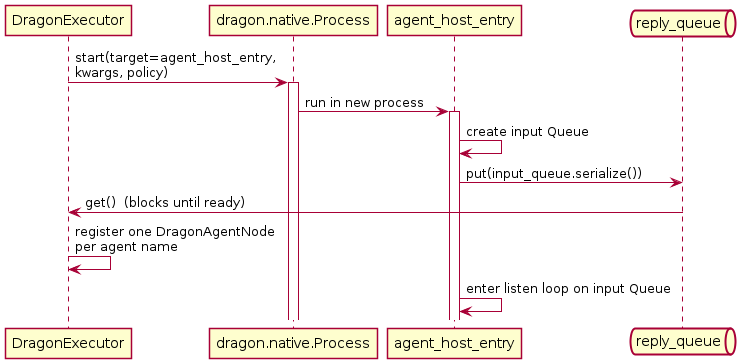
Lifecycle:
Create a Dragon
Queueand send its serialized handle back to the coordinator over the handshakereply_queue.Run one asyncio loop: receive each task message and dispatch it as a concurrent task —
await fn(state)for an async node, or offloadfn(state)to the thread pool for a sync node.Each task serializes a completion envelope and puts it inline on the task’s done-Queue (the shared completion
Queuehanded in per task).Exit cleanly on the
Nonesentinel, draining in-flight tasks first.
If a task names an unknown agent, the host still sends an error envelope so the caller never blocks forever.
Note
The async-loop contract (and its blast radius). Because async nodes share
one loop, the standard asyncio rule applies: an async def node must not
block the loop — a synchronous blocking call, or a long CPU-bound stretch,
without await stalls every other agent co-located on that host until it
returns. The blast radius is that one host process; other hosts are separate
processes with their own loops. This is the normal responsibility of any async
code — wrap blocking work in await asyncio.to_thread(...). You do not
need to know about co-location to write a correct async node: following the
standard rule is sufficient, and co-location only changes who is affected if
the rule is broken. Plain def nodes are never subject to this — they run on
their own thread.
4.3 — DragonAgentNode (the seam)
DragonAgentNode (_node.py) is the fn(state) -> dict callable LangGraph
sees. It holds no per-task state; it just forwards to the watcher:
__call__(state)— synchronous path used bygraph.invoke. LangGraph runs it inside aBackgroundExecutorthread that parks onfuture.result().acall(state)— asynchronous path used bygraph.ainvoke. It awaits anasyncio.Future, suspending the coroutine on the event loop instead of parking a thread. N concurrent agents in a superstep therefore cost zero extra threads — only the event loop plus the watcher thread(s).
4.4 — DragonWatcher (result router)
DragonWatcher (_watcher.py) is the heart of the control plane. Its
dispatch and return paths — and the four parts of a shard (completion Channel,
recv thread, pending table, slots semaphore) — are diagrammed in
§3; this section covers the design rationale.
Why one shared Channel, not a per-task channel. A Dragon Channel is a true
multi-producer / single-consumer durable queue: every message sent is reliably
enqueued and later received, whether or not the consumer happens to be parked in
recv at that instant. Carrying the result as a queued message (rather than
an edge-triggered event, as a ChannelSet bcast_wait would) means a completion
can never be lost to a missed wakeup — so no task is ever left hanging. The
watcher is still fully event-driven: recv_bytes(timeout=None) parks the
thread in the kernel (zero CPU when idle) and wakes the instant a message
arrives. No polling.
Sharding (``num_shards``). The per-message route step
(recv_bytes → cloudpickle.loads → resolve Future) is serial on one
thread. Setting num_shards > 1 creates that many independent lanes
(_Shard — its own Channel, recv thread, semaphore, and pending table); tasks
are partitioned by hash(task_id) % num_shards, so each shard owns a disjoint
slice and no lock is ever contended across shards. Raise it only when a single
watcher thread becomes the bottleneck (very high completion rate of small
results).
Backpressure. max_concurrent_tasks caps simultaneous in-flight tasks via
a BoundedSemaphore (split evenly across shards). It has a fixed default
(64); pass a value to raise or lower it (see
§4.1). When the
cap is hit, a further dispatch waits for a task to complete — the sync path
(submit_task) blocks its calling BackgroundExecutor thread, while the
async path (submit_task_async) awaits the slot without blocking the event
loop (the blocking wait is offloaded to a worker thread), so graph.ainvoke
stays responsive under backpressure. Each shard’s Channel is
sized to per_shard_ring + headroom, so the channel can never overflow even if
every in-flight task completes at once. Total tasks over the executor’s lifetime
are unlimited — only peak concurrency matters.
Sizing cheat-sheet. You tune exactly one number —
max_concurrent_tasks — and everything else is derived from it, so no number is
ever a silent second bottleneck:
Number |
What it is / how it’s set |
|---|---|
|
Max tasks in flight (dispatched but not yet completed) at once. Fixed default 64; raise for more parallelism, lower to use less memory. Everything below follows from it. |
Per-shard slots |
|
Completion Channel capacity |
|
Host input Queue size |
|
|
Number of parallel receive/decode lanes. Raise only if one watcher thread can’t keep up with the completion rate (default 1). |
|
Threads for sync ( |
In one line: set ``max_concurrent_tasks``; the semaphore, the completion channels, and the host input queues all size themselves from it.
Choosing ``max_concurrent_tasks`` and ``max_threads`` together. Both have sensible defaults and both are yours to override — but they bound different things:
max_concurrent_tasks(coordinator) bounds tasks in flight across the whole system.max_threads(per host) bounds how many sync (def) node bodies run at once inside one host (they run on a thread pool). Async (async def) nodes do not use that pool — they run on the host’s shared event loop, bounded only bymax_concurrent_tasks.Async (I/O-bound) agents: the cap is the real limiter — raise it freely for more concurrency;
max_threadsdoes not gate them.Sync agents: admitting far more than a host’s
max_threads(cap≫ per-host sync threads) just queues them — more coordinator/host memory and latency, no extra throughput (a host runs at mostmax_threadssync bodies at a time). Sizing the cap near the sync-thread capacity keeps workers busy without a backlog.
Neither knob changes the other: the cap never spawns host threads, and raising
max_threads never widens the cap. Set them deliberately — you own the
behavior of the combination you pick.
Return-message collection (fan-in). This is where results from every host in
the allocation converge. Regardless of how many AgentHost processes are running
or how wide a superstep fans out, every completion is funneled back through the
same small set of shard channels and resolved by the shard’s single recv thread —
multiple hosts (the producers) send envelopes into the sharded completion
channels, and each shard’s recv thread (the consumer) drains its channel and
matches each envelope to a waiting Future by task_id:
![@startuml
skinparam shadowing false
skinparam componentStyle rectangle
' ---- Producers: agent threads across many hosts/nodes ----
package "AgentHost A (node 0)" {
[planner()] as PA
[runner_0()] as RA
}
package "AgentHost B (node 1)" {
[runner_1()] as RB
[runner_2()] as RC
}
package "AgentHost C (node 2)" {
[analyzer()] as AC
}
' ---- Sharded completion transport in the coordinator ----
package "DragonWatcher (coordinator)" {
queue "Completion Channel 0\n(Global Services)" as CH0
queue "Completion Channel 1\n(Global Services)" as CH1
[recv thread 0\nrecv_bytes(timeout=None)] as T0
[recv thread 1\nrecv_bytes(timeout=None)] as T1
[pending table 0\n{task_id -> Future}] as P0
[pending table 1\n{task_id -> Future}] as P1
[Futures\n(sync + asyncio)] as FUT
}
' ---- Producers send envelopes to the shard chosen at dispatch ----
PA -[#green]-> CH0 : envelope\n{task_id, status, payload}
RA -[#green]-> CH1 : envelope
RB -[#green]-> CH0 : envelope
RC -[#green]-> CH1 : envelope
AC -[#green]-> CH0 : envelope
' ---- Each shard drains its own channel independently ----
CH0 --> T0 : durable MPSC queue\n(never a missed wakeup)
CH1 --> T1
T0 -> T0 : cloudpickle.loads
T1 -> T1 : cloudpickle.loads
T0 --> P0 : pop(task_id)
T1 --> P1 : pop(task_id)
P0 --> FUT : set_result / call_soon_threadsafe\n+ release backpressure slot
P1 --> FUT
@enduml](../_images/plantuml-52003a2991ce891ea31cd9b2d2cc4f45acfaea06.png)
Reading the diagram: the number of consumer threads is fixed at num_shards —
not the number of hosts or the width of a superstep — so the coordinator’s
footprint stays constant no matter how wide the allocation fans out. In effect the
shards are a fixed-width fan-in: the entire allocation’s results are collected
through num_shards lanes and demultiplexed to the correct Futures purely by
table lookup.
4.5 — Completion envelope (_constants.py)
The host and watcher agree on a tiny cloudpickle’d dict per completion:
{
  "task_id": str,                       # routes to the pending Future
  "status":  "done" | "error",
  "payload": <result_dict | exception>,
}
The field-name constants live in _constants.py so the two sides can never
drift. On success the agent’s return value rides inline; on failure the exception
is carried inline (falling back to a RuntimeError with the text if the
exception object cannot be pickled).
5 — Data-Plane Scaling: Central Store vs Node-Local DDict
The three planes were defined in §1. The data
plane is the one that decides whether a data-heavy campaign scales: bulk
artifacts live in a user-managed DDict and only a lightweight handle/key
crosses LangGraph state, so the watcher stays a pure signal router and the
coordinator never materializes gigabytes of intermediate data. It is worth
seeing why that matters, by contrast with the usual central-store approach.
Before: the central-store funnel
Without Dragon, a LangGraph orchestrator on one node glues itself to heavy compute elsewhere through the filesystem or a central store (Redis, shared FS). Even with the “handle-in-state” pattern (store the payload under a key, pass the key), the bulk still lives in one server: every producer writes it over the network and every consumer reads it back over the network — the consumer can never be moved to the data. That server’s RAM and NIC are the ceiling.
![@startuml
skinparam shadowing false
skinparam componentStyle rectangle
node "Login / single node" {
[LangGraph orchestrator] as ORCH
}
database "Central store\n(Redis / shared FS)" as REDIS
node "Compute node 1" {
[producer job] as J1
}
node "Compute node 2" {
[consumer agent] as K1
}
ORCH --> J1 : submit (+ key in state)
J1 -[#red]-> REDIS : write 2 GB over TCP
REDIS -[#red]-> K1 : read 2 GB back over TCP\n(consumer can't move to data)
K1 ..> ORCH : small result / key
@enduml](../_images/plantuml-689906525edaf6443fae42c64241a395548613a4.png)
After: node-local DDict + data-aware placement
With Dragon the agent layer runs inside the allocation. A producer writes its large result to the node-local DDict manager (zero-copy, no network) and returns only a key through LangGraph state. The consumer is placed on the node where the data lives, so its read is local; Dragon uses the HPC interconnect (RDMA/HSTA) only when a read must cross nodes. The orchestrator only ever sees handles.
![@startuml
skinparam shadowing false
skinparam componentStyle rectangle
node "Head node" {
[LangGraph graph\n+ DragonExecutor] as EX
}
node "Compute node A" {
[Producer agent] as A1
database "DDict manager\n(node-local shmem)" as D1
A1 -[#green]-> D1 : write 2 GB LOCAL\n(zero-copy)
}
node "Compute node B" {
[Consumer agent\nplaced where data lives] as A2
}
EX --> A1 : dispatch (handle)
A1 ..> EX : return KEY only
EX --> A2 : dispatch (handle)
A2 ..> EX : small result
D1 .[#blue].> A2 : cross-node read over RDMA\n(only if remote)
@enduml](../_images/plantuml-9ceb68d6be64e0233a4a1335ee9a16770bbd5ef2.png)
Note
Locality and placement are properties of the Dragon runtime
(ProcessGroup + a node Policy + DDict), available with or without
LangGraph. This integration’s job is to let an existing LangGraph graph reach
that substrate without a rewrite — it does not, by itself, own locality. The
data-plane win is real only for data-heavy results; for small JSON/text
payloads a central store is perfectly adequate.
6 — Sync vs Async Concurrency
What is the same. invoke and ainvoke share the entire pipeline —
the same dispatch, the same watcher, the same backpressure semaphore, and, most
importantly, the same host-side execution. Whichever you call, a node runs on
the host the same way: a sync (def) node on the host’s thread pool, an async
(async def) node on the host’s event loop. The driver does not change
where or how your node runs, and both produce the identical result. Your node’s
sync/async-ness is therefore independent of the invoke/ainvoke choice.
What differs — only how the coordinator waits. The single difference is on the caller side: how the coordinator waits for each node’s Future.
Path |
|
|
|---|---|---|
Node entry |
|
|
Future type |
|
|
Caller waits by |
parking a LangGraph |
suspending the coroutine on the event loop |
Coordinator threads for N concurrent nodes |
up to N (one parked thread per in-flight node) |
0 extra (only the loop + watcher thread) |
The watcher resolves async futures via loop.call_soon_threadsafe from its recv
thread, which is why ainvoke can fan out to many concurrent agents without
spawning a thread per node.
The same split applies to backpressure. When in-flight tasks reach
max_concurrent_tasks, the wait for a free slot follows the caller’s
concurrency model: invoke blocks its BackgroundExecutor thread, while
ainvoke awaits the slot — the blocking wait is offloaded to a worker thread
so the event loop keeps turning and resolving completions (which is exactly what
frees slots), instead of freezing. In both cases the single BoundedSemaphore
per shard remains the one budget, so the completion-channel-can’t-overflow
guarantee is unchanged.
When to use which — this matters as you scale concurrent agents. Because the host runs your nodes identically either way, the choice is purely about the coordinator’s cost of waiting, which scales with how many nodes are in flight at once (a superstep’s fan-out width). Know what happens under the hood so you pick responsibly:
ainvokeis a functional superset — anythinginvokedoes it can do (wrap it:asyncio.run(graph.ainvoke(...))). Its only requirement is that you call it from an event loop. It adds no capability overinvoke; it only changes how the coordinator waits.Chain or modest fan-out (one, or a handful of, nodes in flight at a time):
invokeparks that manyBackgroundExecutorthreads onfuture.result()— idle threads (memory + a scheduler slot, no CPU), so the overhead is negligible. Andinvokeis simpler: a plain blocking call, no event loop, linear stack traces. Prefer ``invoke`` here when your driver is synchronous.Wide fan-out (tens/hundreds/thousands of nodes concurrent in one superstep):
invokeneeds one coordinator thread per in-flight node and can saturate LangGraph’s sync executor pool (serializing work beyond the pool size), whileainvokeawaits every node on one event loop at ~zero threads each. Prefer ``ainvoke`` when you scale concurrency — it is the difference between N parked threads (and a possible pool bottleneck) and none.
Rule of thumb: pick the driver by your caller’s shape and fan-out width,
not by your node bodies. Synchronous driver + narrow graph → invoke; async
application or wide fan-out → ainvoke. Either way, max_concurrent_tasks
still caps total in-flight work regardless of the driver (see
§4.4).
7 — Dragon Primitives Used
The integration is built on a small set of Dragon primitives. Understanding which primitives are used and where is key to understanding the architecture.
Primitive |
Module |
Role in LangGraph Integration |
|---|---|---|
|
Host input queues and the startup handshake reply queue. One Queue per AgentHost process, shared by all agents on that host. The primary dispatch mechanism (coordinator → host). |
|
|
Shared completion channel (one per shard), created through Global Services and attached from its serialized descriptor — which is what makes it reachable from hosts on remote nodes. All hosts enqueue result envelopes; the watcher’s recv thread drains it. Durable MPSC queue — messages are never lost. |
|
|
|
|
|
Only |
|
|
Send/receive handles for the completion channel. One send handle per agent thread (opened per task), one recv handle per watcher shard (persistent). |
|
|
AgentHost process lifecycle. One Process per |
|
|
Optional placement control — pin a host to a specific cluster node,
NUMA zone, or GPU set. Passed via |
Dragon import concentration. Only 3 of 6 source files contain dragon.*
imports:
File |
Dragon primitives |
|---|---|
|
|
|
|
|
|
The remaining files (__init__.py, _node.py, _constants.py) are pure
Python with no Dragon imports.
8 — Error Handling
The integration handles errors at every boundary:
Scenario |
Handling |
|---|---|
Agent function raises |
Exception is packed into an error envelope ( |
Unpicklable exception |
The Queue’s |
Unknown |
Host logs the error and sends a |
Task timeout |
Sync: |
Host process crashes |
No envelope arrives. If |
Dispatch failure |
If |
Coordinator crashes |
Use a persistent LangGraph checkpointer ( |
All error paths guarantee that exactly one of these happens for every dispatched task:
The Future is resolved with a result, or
The Future is resolved with an exception, or
The caller’s timeout fires.
No task is ever left hanging indefinitely (provided event_timeout is set
or the host process remains alive).
9 — Lifecycle & Memory Management
The lifecycle of every resource managed by this integration:
DragonExecutor()
  ├─ Attaches to the default MemoryPool (once, not per shard)
  ├─ Creates ONE shared completion Channel per shard
  │    via Global Services, in that default pool
  └─ Starts ONE watcher recv thread (per shard)

executor.launch_host(agents={...}, policy=...)
  ├─ Creates Dragon Process (persistent)
  ├─ Process creates input Queue, sends handle back (handshake)
  └─ Executor creates DragonAgentNode per agent name

[... graph runs, tasks dispatched ...]

Per task (HOT PATH — nothing created/destroyed):
  ├─ Acquire backpressure slot (semaphore)
  ├─ Register Future in pending table
  ├─ Queue.put(msg) → host
  ├─ fn(state) → result (async: on the host loop; sync: on the thread pool)
  ├─ ChannelSendH.send_bytes(envelope) → watcher
  ├─ recv_bytes() → decode → resolve Future
  └─ Release backpressure slot

DragonExecutor.shutdown() / __exit__()
  ├─ Send None sentinel to each host's input Queue
  ├─ Host stops accepting work, drains in-flight tasks, closes its pools
  ├─ proc.join(timeout=10), then proc.kill()
  └─ watcher.stop()
       ├─ Send stop sentinel envelope to each shard's channel
       ├─ Join each shard's recv thread
       ├─ Close recv handles
       ├─ Per shard: release_refcnt(cuid) → destroy(cuid) (Global Services)
       └─ Detach the default MemoryPool (never destroyed — shared
          runtime infrastructure)
Memory guarantee: This layer never leaks resources. The shared completion Channels are created once at startup through Global Services and released and destroyed the same way on executor exit; the default MemoryPool they live in is only attached and detached, never destroyed, because it is shared runtime infrastructure. No Dragon objects are created or destroyed on the hot path (per task).
User-managed DDict: Any DDict you create is yours to manage. The executor
neither creates nor destroys it. Free it (del keys / ddict.destroy())
when your experiment finishes.
10 — Multi-Node Deployment
Each launch_host() call spawns one Dragon Process. Use a Policy to place
each host on a specific cluster node:
![@startuml
skinparam shadowing false
skinparam componentStyle rectangle
skinparam nodesep 14
skinparam ranksep 26
node "Node 0 (coordinator)" as N0 {
[LangGraph graph\n+ DragonExecutor] as GRAPH
[DragonWatcher\n(recv thread)] as WATCH
GRAPH --> WATCH
}
node "Node 1 (agents)" as N1 {
frame "AgentHost" {
[researcher\n(thread)] as RES
[writer\n(thread)] as WRI
}
[Shared LLM proxy] as LLM1
}
node "Node 2 (GPU inference)" as N2 {
[vLLM\n(tp=4 GPUs)] as VLLM
}
node "Node 3 (compute)" as N3 {
frame "AgentHost" {
[simulator\n(thread)] as SIM
}
database "DDict\n(node-local)" as DD
SIM --> DD : write bulk\n(zero-copy)
}
WATCH --> RES : input Queue
WATCH --> SIM : input Queue
RES --> WATCH : completion Channel
SIM --> WATCH : completion Channel
LLM1 .[#blue].> VLLM : inference Queue
@enduml](../_images/plantuml-98df7fae5680d15571e830030be76b0b164687d1.png)
Fig. 42 Multi-node deployment — where each component runs.
All communication uses the Dragon primitives catalogued in
§7: Queue for task dispatch and the
startup handshake, one shared Channel per shard for completions, Process
per launch_host() call, Policy for placement, plus the user-owned
DDict and any ProcessGroup an agent launches.
11 — Usage Patterns
Pattern A — Single host, all agents together (simplest)
with DragonExecutor() as executor:
    executor.launch_host(agents={"a": fn_a, "b": fn_b, "c": fn_c})
All agents share one process, one thread pool, one set of resources.
Pattern B — Multi-node, explicit placement (batch style)
with DragonExecutor() as executor:
    executor.launch_hosts(
        hosts=[
            {"researcher": fn},
            {"analyzer": fn, "writer": fn},
        ],
        policies=[policy_node0, policy_node1],
    )
One host per node. Each entry in policies is applied to the corresponding
host. Agents on the same node share resources; agents on different nodes are
isolated.
Pattern C — GPU isolation (one host per GPU)
with DragonExecutor() as executor:
    executor.launch_hosts(
        hosts=[
            {"gpu_agent_0": fn},
            {"gpu_agent_1": fn},
        ],
        policies=[gpu0_policy, gpu1_policy],
    )
Pattern D — With Dragon Inference (on-cluster LLM)
Call get_llm() inside an async node, passing
the inference pipeline’s queue handle. The proxy is built lazily in the host
process and cached per pipeline, so it binds to the host’s event loop and is
reused across calls. Do not build the proxy on the coordinator and pass it
in — it is loop-bound and per-process.
from dragon.ai.langgraph import DragonExecutor, get_llm

input_queue = Queue()                       # the inference pipeline's ingress
Process(target=start_inference, args=(input_queue,),
        policy=gpu_policy).start()

async def researcher(state):                # async node → runs on the host loop
    resp = await get_llm(input_queue).chat([...])   # built once, in the host
    return {"research": resp}

with DragonExecutor() as executor:
    executor.launch_host(agents={"researcher": researcher})
    graph.ainvoke(...)                      # async driver
Two models on one host is just two queues — each get_llm(q) returns that
pipeline’s own cached proxy:
async def a(state): return {"x": await get_llm(llama_q).chat([...])}
async def b(state): return {"y": await get_llm(mistral_q).chat([...])}
(If your inference service exposes an OpenAI-compatible HTTP endpoint, you can
instead use a normal ChatOpenAI(base_url=...) created once at module scope —
lowest friction, at the cost of HTTP transport instead of Dragon Channels.)
Pattern E — Agent dispatches HPC compute; bulk stays in user’s DDict
from dragon import DDict
from dragon.ai.langgraph import get_llm

sim_data = DDict(managers_per_node=1, total_mem=10_000_000_000)

async def simulation_agent(state):
    plan = await get_llm(input_queue).chat([...])
    pg = ProcessGroup(nproc=256, policy=compute_policy)
    pg.start(target=run_sim, args=(plan, sim_data))
    pg.join()
    return {"result_key": "sim_output_42"}  # handle only

with DragonExecutor() as executor:
    executor.launch_host(agents={"simulate": simulation_agent})