Inference Service
This document explains the implementation of dragon.ai.inference for
developers who need to maintain, debug, or extend the service. For hands-on
usage, see Dragon Inference Service - User Guide. For generated API documentation, see
Inference.
What the Service Does
The inference service is a Dragon-native LLM serving stack. It combines Dragon process placement and queues with vLLM tensor-parallel generation. The service is designed around one shared request queue and many callers. Callers submit a prompt and a response queue. Backend workers pull requests, optionally batch and filter them, run vLLM, and put a response dictionary on the original response queue.
The implementation is deliberately split into small subsystems:
Inferenceowns lifecycle, hardware discovery, node/GPU subdivision, CPU worker process groups, and the shared shutdown event.CPUWorkerowns a set of GPU model workers on one node and forwards work from the public input queue into local worker queues.InferenceWorkerruns the preprocessing and vLLM loops. Depending on configuration, an inference worker is one process or a preprocessing process plus an LLM process.LLMInferenceEnginewraps vLLM construction, sampling parameters, generation, metrics, and shutdown.DragonQueueLLMProxyis the client-side chat interface used by the agent framework and other async applications.
Source Code Layout
All inference service code lives in src/dragon/ai/inference/.
inference/
|-- __init__.py
|-- batching.py              # BatchItem, Batch, DynamicBatcher
|-- config.py                # Dataclass configuration and YAML parsing
|-- config.sample            # Sample YAML configuration
|-- cpu_worker_utils.py      # CPUWorker lifecycle and dynamic workers
|-- guardrails.py            # GuardrailsProcessor
|-- inference_utils.py       # Inference service entry point
|-- inference_worker_utils.py # Preprocessing loop and LLM loop
|-- llm_engine.py            # vLLM wrapper and chat formatting helpers
|-- llm_proxy.py             # LLMProxy and DragonQueueLLMProxy
|-- prompt_guard_utils.py    # PromptGuard model wrapper
|-- reader_utils.py          # Metrics readers and consolidation
`-- patch_vllm/              # Dragon vLLM compatibility plugin
When looking for behavior:
Service startup:
inference_utils.py:Inference.initializeService teardown:
inference_utils.py:Inference.destroyDirect prompt submission:
inference_utils.py:Inference.queryChat request submission:
llm_proxy.py:DragonQueueLLMProxy.chatStreaming chat requests:
llm_proxy.py:DragonQueueLLMProxy.chat_streamStreaming generation:
llm_engine.py:LLMInferenceEngine.generate_streamStreaming types:
llm_engine.py:StreamChunk, STREAM_DONE_SENTINELHardware validation:
config.pyandInference.maybe_subset_nodes_gpusCPU head routing:
cpu_worker_utils.py:CPUWorker.initializeDynamic worker decisions:
cpu_worker_utils.py:CPUWorker.dynamic_inf_workersBatching and guardrails:
inference_worker_utils.pyvLLM construction and generation:
llm_engine.py:LLMInferenceEngine
Dragon Primitives Used
Primitive |
Module |
Role |
|---|---|---|
|
Public request queue, per-request response queues, CPU-to-worker queues, preprocessing-to-LLM queues, and dynamic worker manager queues. |
|
|
Global service shutdown, LLM process shutdown, and inference-worker spin-down signaling. |
|
|
Startup synchronization for CPU workers and model workers. |
|
|
Groups CPU head workers and each inference worker’s processes. |
|
|
Process target, arguments, working directory, and placement policy. |
|
|
Host placement for CPU heads and GPU affinity for LLM processes. |
|
|
Discovers nodes and GPUs in the current Dragon allocation. |
|
|
Records latency and throughput metrics from worker processes. |
Initialization Flow
The top-level Inference object performs the setup work before any backend
process is launched.
Store the
InferenceConfigand copy frequently used values onto the instance.Create the global
end_eventand store the publicinput_queue.Discover allocation nodes with
System()andNode(node_id).Validate hardware, model, batching, guardrails, and dynamic worker settings.
Apply
num_nodes,num_gpus, andnode_offsetto choose the resource slice for this service.Split GPUs into inference-worker device groups of size
tp_size.Group inference workers under CPU head workers according to
num_inf_workers_per_cpu. When this value is-1, it is auto-calculated asnum_gpus // tp_size(minimum one) using the resolved GPU count.Create a CPU worker
ProcessGroupand a startupBarrierwith one slot for the parent plus one slot for each CPU head.Create a Dragon
Telemetryobject.Resolve
inf_wrkr_queue_maxsizefor the inference worker input queue. When this value is-1, it defaults tonum_inf_workers_per_cpu * 2.Build shared CPU worker constructor kwargs.
Inference.initialize() then creates one CPU worker process per CPU head with
a host-name placement policy. Each CPU worker subsequently creates its own local
inference worker process groups.
Runtime Request Flow
The direct text path and proxy chat path converge on the same backend queue.
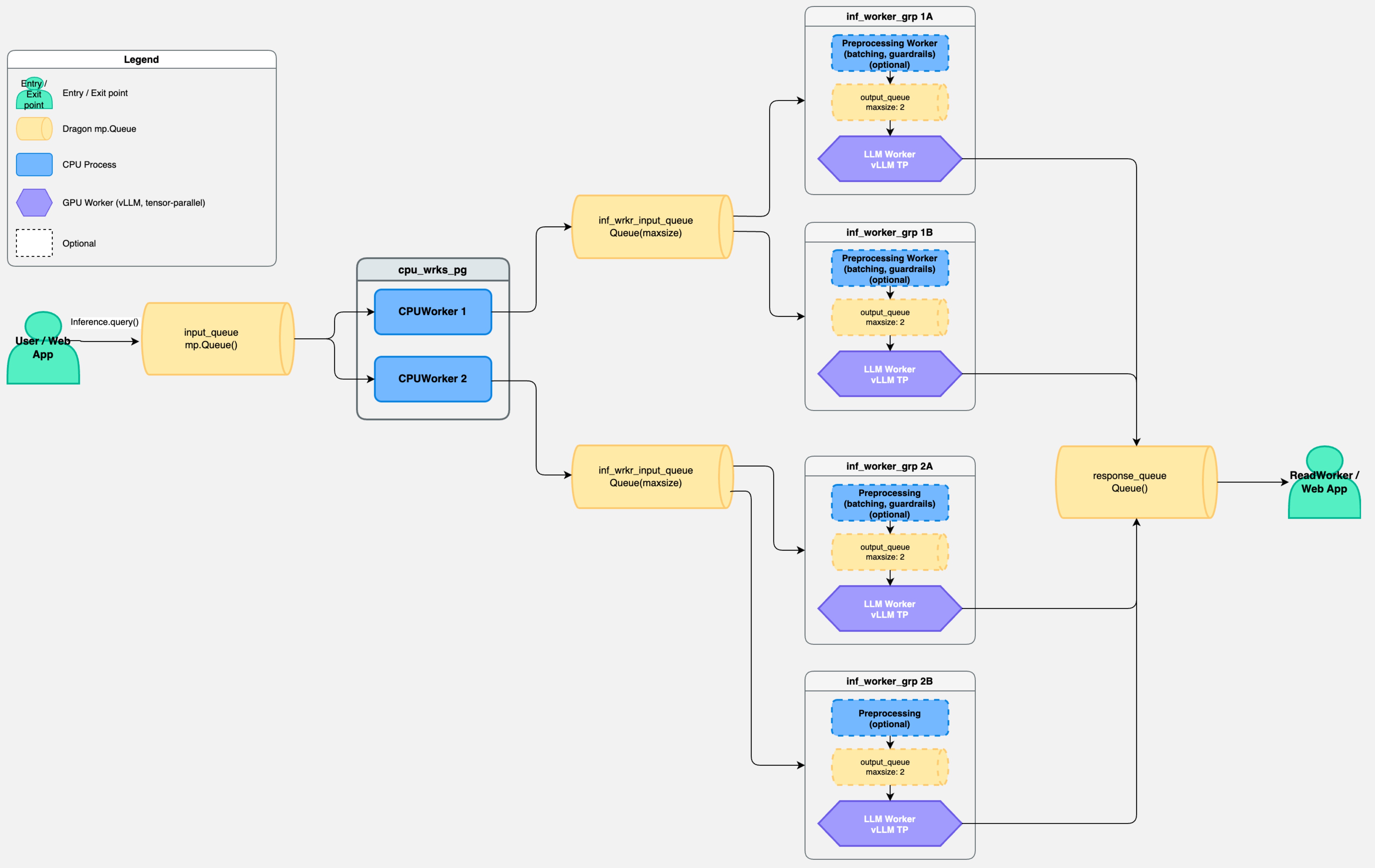
Fig. 43 Dragon inference data flow
Fig. 43 is an example of the internal data flow,
not a fixed service size. The diagram shows one public input_queue receiving
Inference.query() requests from a user or web application. A CPU worker
process group, cpu_wrks_pg, contains two CPU workers. Each CPU worker reads
from the shared input queue and forwards requests to its own local
inf_wrkr_input_queue instances.
In this example each CPU worker owns two inference worker process groups. The
first CPU worker routes to inf_worker_grp 1A and inf_worker_grp 1B; the
second CPU worker routes to inf_worker_grp 2A and inf_worker_grp 2B.
Each inference worker group contains one LLM worker and may also contain a
preprocessing worker. The preprocessing worker appears as optional because it is
created only when dynamic batching or guardrails need CPU-side work before
generation. When preprocessing is enabled, it batches requests, applies
guardrail filtering, and forwards safe work through that group’s output queue.
When preprocessing is disabled, the LLM process reads directly from the local
inference worker input queue.
The purple LLM worker blocks represent vLLM tensor-parallel generation. Each
LLM worker consumes model.tp_size GPUs. With tp_size=2, every
inference worker group in the diagram would use two GPUs; the four groups shown
would therefore require eight GPUs. With tp_size=1, the same four groups
would require four GPUs. The number of CPU workers, inference worker groups,
queue sizes, and GPU ranks are all determined by HardwareConfig,
BatchingConfig, and ModelConfig rather than by the diagram itself.
Responses flow back through the per-request response_queue to the caller or
read worker. Along the way, the CPU worker records queue latency, the
preprocessing worker records batching or guardrail timing when present, and the
LLM process formats chat requests, invokes vLLM, records model metrics, and
writes the response dictionary back to the original response queue.
Caller or Agent
    |
    |  Inference.query((prompt, response_queue))
    |  or await DragonQueueLLMProxy.chat(messages)
    |  or async for chunk in DragonQueueLLMProxy.chat_stream(messages)
    v
Input Dragon Queue
    |
    v
CPUWorker on selected node
    |
    |  adds CPU latency metadata
    |  starts inference workers
    v
InferenceWorker preprocessing process (optional)
    |
    |  optional dynamic batching
    |  optional PromptGuard filtering
    v
InferenceWorker LLM process
    |
    |  tokenizer chat template for chat requests
    |  vLLM generate() or generate_stream()
    |  telemetry metric calculation
    v
Response queue (dict for batch, StreamChunk for streaming)
Inference.query() builds OpenAI-format message dicts from plain text prompts
and the configured system prompt. It puts (prompt, messages, response_queue,
timestamp) onto the input queue.
DragonQueueLLMProxy.chat() creates an InferenceRequest named tuple. The
first four fields intentionally match the direct tuple layout, and optional
fields carry tools, per-request JSON schema overrides,
continue_final_message, and stream. The proxy owns a bounded pool of
response queues; pool exhaustion is the caller-side backpressure mechanism.
DragonQueueLLMProxy.chat_stream() creates an InferenceRequest with
stream=True. The LLM worker detects this and uses generate_stream()
instead of batch generate(), putting StreamChunk objects on the response
queue followed by STREAM_DONE_SENTINEL.
CPU Worker Responsibilities
CPUWorker is the node-local head process for a group of inference workers.
It owns:
A local queue feeding the assigned inference workers.
A dynamic worker manager queue containing available worker device groups.
Output queues and end events for worker cleanup.
The main loop that receives public requests and forwards them locally.
At startup, every configured inference worker is created. If dynamic worker
management is enabled, idle extra workers can later shut down. When a worker
shuts down, the LLM loop returns its (hostname, devices, inf_worker_id) to
the CPU worker’s manager queue. If enough prompts arrive within
spin_up_threshold_seconds, the CPU worker pulls one available worker
configuration from that manager queue and starts it again.
Dynamic worker management never removes the first
min_active_workers_per_cpu workers under a CPU head.
Inference Worker Modes
CPUWorker.create_inf_worker() creates a process group for each inference
worker. The group always includes one LLM process. It also includes one
preprocessing process when either guardrails are enabled or dynamic batching is
enabled.
- No preprocessing process
Used when guardrails are disabled and batching is disabled or pre-batching is used without guardrails. The LLM process reads directly from the local CPU worker queue.
- Preprocessing process
Used for dynamic batching and guardrails. The preprocessing process reads local requests, optionally batches and filters them, then sends a uniform tuple to the LLM process.
This split keeps CUDA and vLLM state inside the LLM process and keeps CPU-only batching and PromptGuard work outside the LLM loop.
Batching
DynamicBatcher collects BatchItem instances until one of two conditions
is true:
The batch reaches
max_batch_size.The first item has waited at least
batch_wait_seconds.
Every BatchItem carries the raw prompt, formatted prompt or chat messages,
the response queue, latency metadata, and optional chat fields. When a batch is
ready, the preprocessing worker filters it if guardrails are enabled and then
forwards safe requests to the LLM process.
Pre-batch mode bypasses DynamicBatcher. The caller sends a list of prompts,
and the backend treats that list as the batch.
Guardrails
Guardrails are implemented by GuardrailsProcessor and PromptGuard.
PromptGuard loads a Hugging Face sequence classification model, evaluates
prompt text, and returns jailbreak scores. GuardrailsProcessor compares
those scores against prompt_guard_sensitivity.
For chat requests, InferenceWorker._extract_user_text() concatenates all
role == "user" messages before classification. This prevents system and
assistant messages from dominating the safety score and checks the actual user
input across multi-turn requests.
Unsafe prompts are removed from the batch in lockstep with their tools, schema overrides, and continuation flags. The worker writes a rejection response to the original response queue and records zero model latency and throughput for that request.
vLLM Integration
LLMInferenceEngine.initialize() sets the environment required by vLLM and
then creates vllm.LLM inside the worker process. Notable settings include:
tensor_parallel_size=config.model.tp_sizedistributed_executor_backend="mp"enforce_eager=Truedisable_custom_all_reduce=Truemax_num_seqs=config.batching.max_batch_sizemax_model_len=config.model.max_model_len
The engine sets HF_TOKEN, MASTER_ADDR, MASTER_PORT,
VLLM_LOGGING_LEVEL, and _DRAGON_DEVICE_OFFSET before importing vLLM.
find_free_port() chooses a deterministic port range based on the first GPU
device assigned to the worker. The plugin under patch_vllm/ is shipped
inside dragonhpc and registered through the vllm.general_plugins entry
point group declared by the package, so vLLM loads it automatically. Its patches
cover engine startup, worker startup, multiprocessing-context selection, and
open-port selection seeded by GPU device ID so co-located vLLM instances avoid
collisions. Each patch checks for _DRAGON_DEVICE_OFFSET and is a no-op when
vLLM runs outside the Dragon inference service.
For chat requests, the LLM loop asks the model tokenizer to
apply_chat_template(). Tools, JSON schema overrides, and
continue_final_message are carried per request, so a single dynamic batch
can contain different chat options. For base models that lack a chat template,
the worker falls back to plain-text concatenation in the format
System: ...\n\nUser: ...\n\nAssistant:.
LLMInferenceEngine.generate() builds per-request sampling parameters when
JSON schemas are present. For vLLM 0.12.0 and newer it uses
StructuredOutputsParams; older vLLM versions use GuidedDecodingParams.
Response and Metrics
The LLM process sends one response dictionary per original request. The dictionary includes worker identifiers, batch size, latency measurements, throughput measurements, original user input, and assistant text.
Metrics are calculated in two places:
LLMInferenceEngine._calculate_metrics()computes inference time, requests per second, token counts, total tokens per second, and output tokens per second from vLLM outputs.InferenceWorker._send_responses()combines engine metrics with queue and preprocessing timestamps and writes values to Dragon telemetry.
reader_utils.py provides helper classes for response reading and metric
consolidation in performance tests.
Streaming Support
The inference service supports token-by-token streaming for low-latency
interactive applications. Streaming is enabled per-request via the stream
field in InferenceRequest.
Data flow for streaming requests:
DragonQueueLLMProxy.chat_stream(messages)
    |
    |  InferenceRequest(stream=True)
    v
Input Dragon Queue
    |
    v
CPUWorker (extracts stream flag at index 7)
    |
    v
InferenceWorker LLM process
    |
    |  detects is_streaming=True
    |  calls LLMInferenceEngine.generate_stream()
    v
vLLM generate(stream=True)
    |
    |  yields RequestOutput per token
    v
StreamChunk objects put on response_queue
    |
    v
STREAM_DONE_SENTINEL put on response_queue
    |
    v
DragonQueueLLMProxy yields chunks to caller
Key components:
StreamChunk: Dataclass containingdelta_text(new tokens),accumulated_text(full text so far),is_finishedflag,finish_reason, andmetrics(populated on final chunk).STREAM_DONE_SENTINEL: Singleton marker indicating end of stream.LLMInferenceEngine.generate_stream(): Generator that iterates vLLM’s streaming output and yieldsStreamChunkobjects.DragonQueueLLMProxy.chat_stream(): Async generator that polls the response queue and yields chunks until sentinel received.
Request tuple format with streaming:
The full request tuple format is now:
(user_prompt, formatted_prompt, response_queue, timestamp,
 tools, json_schema_override, continue_final_message, stream)
Index 7 carries the stream boolean. When stream=True, the LLM worker
bypasses batch generation and processes the single request through
generate_stream().
Compatibility notes:
Streaming requires vLLM 0.5.0 or newer for true token-by-token output. Older vLLM versions fall back to returning the complete response as a single
StreamChunk.Streaming requests bypass dynamic batching and are processed immediately with effective batch size of 1.
Streaming is not currently supported through the preprocessing path (batching or guardrails enabled). When preprocessing is required, streaming requests receive
stream_list=[False]and fall back to non-streaming generation.
Shutdown Flow
Inference.destroy() sets the global end event, waits for CPU workers,
stops and closes the CPU worker process group, and closes the public input
queue.
CPU workers watch the global end event while polling their public input queue. On shutdown they join, stop, and close each active inference worker process group.
Preprocessing workers drain remaining local work where possible before exiting.
LLM workers shut down either when the global end event is set or when dynamic
worker spin-down sets their per-worker LLM end event. LLMInferenceEngine
attempts to shut down the vLLM executor, destroy torch distributed process
groups, empty CUDA cache, and collect CUDA IPC handles.
Extension Points
- Adding a new client transport
Implement
LLMProxy.chat()andLLMProxy.chat_stream()and translate the external request into the existing queue payload. Preserve the first four tuple fields so CPU workers can route it without another code path. For streaming, putStreamChunkobjects on the response queue followed bySTREAM_DONE_SENTINEL.- Adding request metadata
Append optional fields to the request tuple or
InferenceRequestand handle missing fields with length checks. Existing code follows this pattern for tools, JSON schema overrides, continuation flags, and the stream flag. The current tuple format is:(user_prompt, formatted_prompt, response_queue, timestamp, tools, json_schema_override, continue_final_message, stream)
- Changing safety behavior
Extend
GuardrailsProcessoror replacePromptGuard. Keep filtering in lockstep across prompts, response queues, latency metrics, tools, schemas, and continuation flags.- Changing batching policy
Update
DynamicBatcherif the policy is purely CPU-side. If a policy needs model-token information, keep tokenizer access in the LLM process to avoid moving vLLM or CUDA state into preprocessing.- Changing vLLM versions
Reinstall the desired vLLM and re-test
patch_vllm/andLLMInferenceEngine.generate(). The plugin is bundled withdragonhpcand patches vLLM at runtime, so no plugin reinstall or source-editing step is needed. The plugin supportsvllm>=0.11.0,<0.20.0and the code has explicit version branches for structured output APIs, engine startup, worker startup, multiprocessing-context selection, and engine arguments.